
Debates about the food and medical systems have grown louder and more divisive. From vaccine mandates and pharmaceutical influence to discussions over processed foods, regenerative agriculture, and nutritional transparency—and most recently, to the establishment of the Make America Healthy Again commission—Americans are having hard conversations about who or what they can trust when it comes to their health and their food.
For some, these systems are something to reimagine in line with their ideals; for others, they are something to critique as corrupt.
In our webinar, Your Brand and the Post-Pandemic Supplement Consumer, we highlighted the trend that trust in the U.S. medical system has declined since 2020. For supplement brands, this cultural reality directly impacts consumer engagement. But there’s an important nuance: distrust in the medical system isn’t a black-and-white proposition. It depends on how consumers define the system in the first place.
In our proprietary, census-balanced Supplement Consumer PureSegmentation™ research, we found that the way consumers frame the medical and food systems largely shapes how they feel about them. The insight is simple but powerful for supplement brands—it is a key to how a brand can connect emotionally to their target consumers. And because definitions vary dramatically by segment, brands need to look beyond generalizations like “declining trust.” The more meaningful question is: trust in which version of the system?
Defining and Describing the Medical System
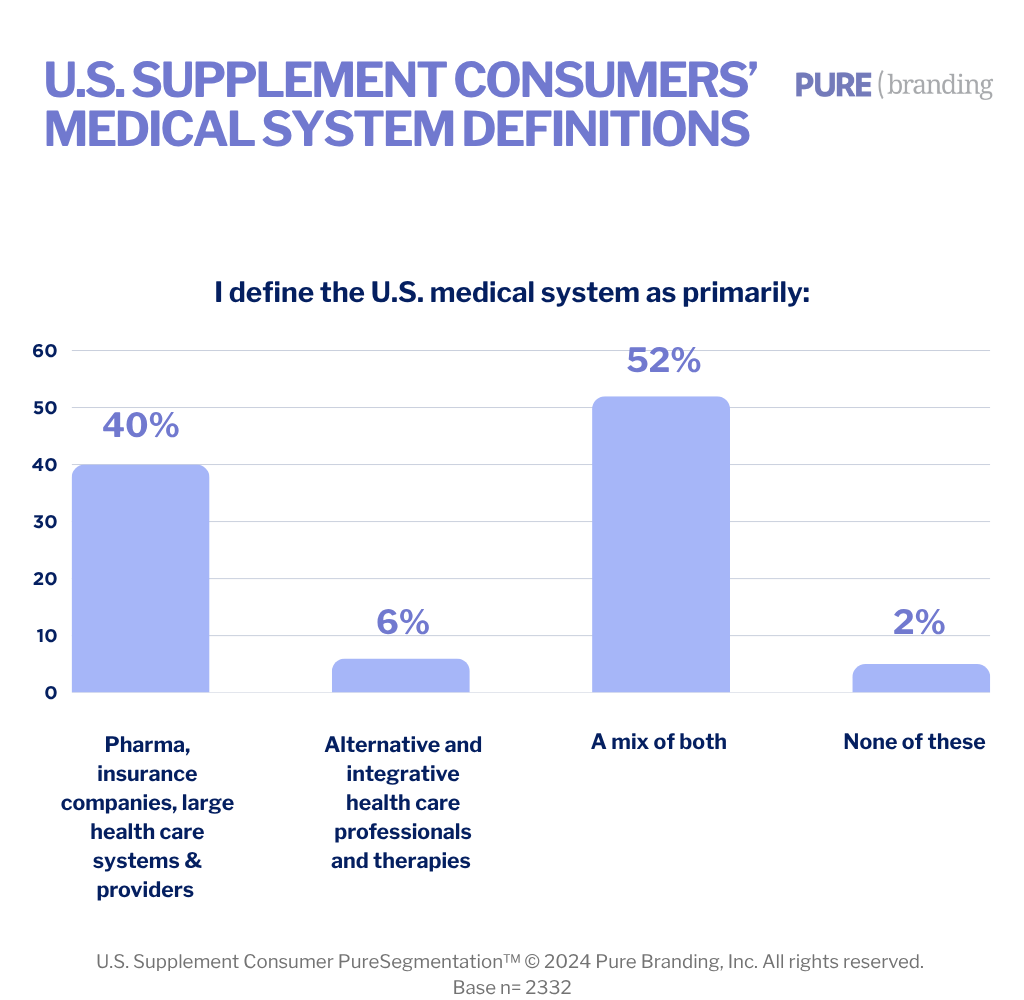
When asked what comes to mind when they hear the term “U.S. medical system,” just over half of supplement consumers (52%) said it’s a mix of conventional and integrative care. Four in ten (40%) said it was primarily pharmaceutical companies, insurance companies, and large hospitals. Only a small fraction (6%) saw it primarily as alternative and integrative healthcare.
When asked to evaluate the medical system, only 7% of consumers called it excellent, and another 17% said it was good. About 16% landed in the middle, calling it okay. But the largest share (58%) described it as flawed: 24% somewhat flawed, 21% seriously flawed, and 13% went further, calling it extremely corrupt and harmful.
Those segments that over-indexed on seeing the system as pharmaceutical companies, insurance companies, and hospitals had the least favorable view. In two segments, 75% rated the system as somewhat flawed to extremely corrupt and harmful—and these were the same groups most likely to define it as dominated by Pharma and insurance.
By contrast, consumers who over-indexed on defining the system as a mix of conventional and integrative care or primarily integrative were more positive. Most telling is the influence of integrative medicine: the segment in which 15% associated the system with integrative care had by far the strongest evaluation, with 60% rating the system as okay to excellent.
Defining and Describing the Food System
When asked what comes to mind when they hear the term “U.S. food system,” 58% of supplement consumers said it is a mix of large-scale agriculture and local or family farms. About three in ten (31%) defined it primarily as large-scale agriculture and national food brands, while only a small minority (8%) associated it primarily with local farms, stores, and markets.
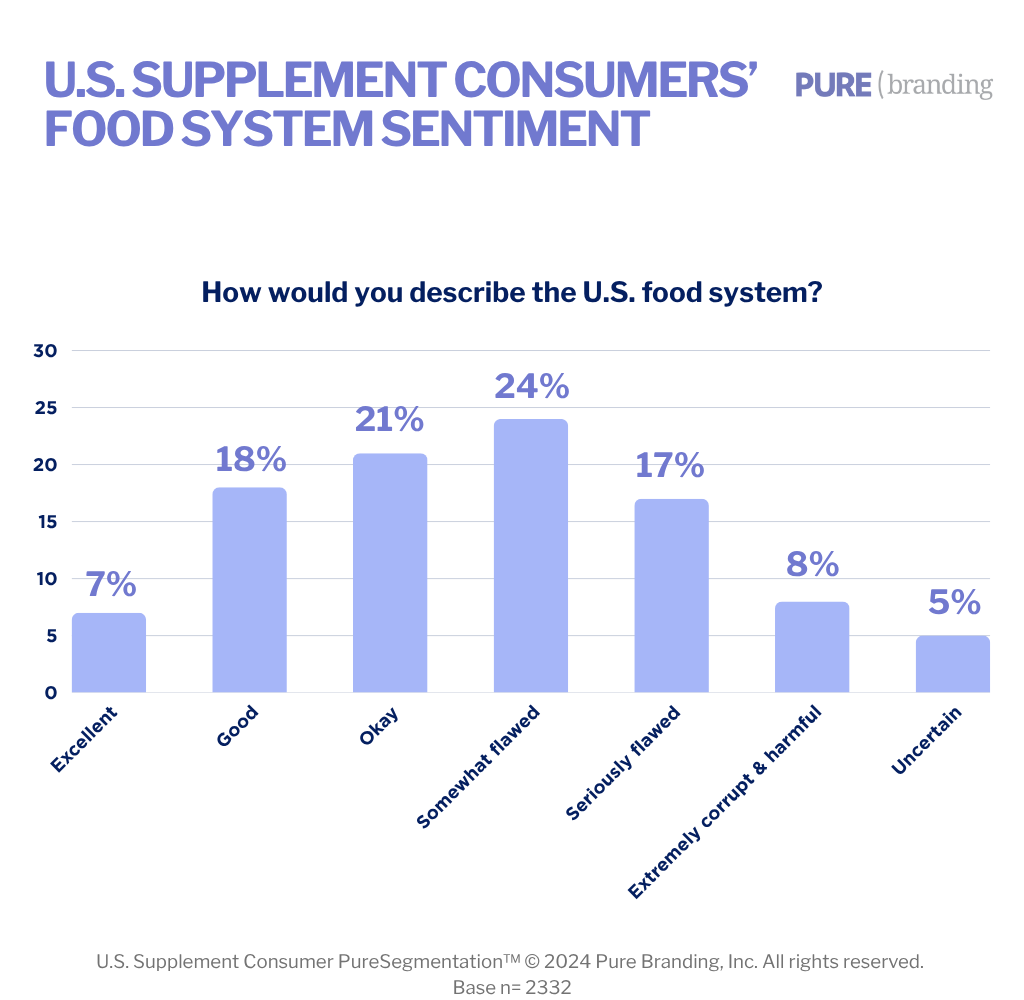
When asked to evaluate the food system, consumers were nearly evenly split between positive/middle and negative views. Forty-six percent rated it as excellent, good, or okay, while 49% described it as somewhat flawed, seriously flawed, or extremely corrupt and harmful. Another 5% were uncertain.
The most critical perspective came from segments that over-indexed on defining the food system as primarily large-scale agriculture. For example, in one segment, 38% gave the food system this definition—the highest of any group—and in that same segment, 76% rated the system as somewhat flawed to extremely corrupt. By contrast, the segments that over-indexed for seeing the system as a mix of large-scale and local were more moderate, clustering around okay and somewhat flawed.
The most favorable perspective came from the smallest group who defined the food system as local farms and markets. While only 20% of one segment chose this definition (vs. 8% of the total sample), that group was by far the most positive, with 31% rating the food system as excellent and another 18% calling it good.
Food Shopping
We can take this one step further by looking at where consumers say they shop for food. More than half of supplement consumers (56%) primarily shop at supermarket chains, discount stores, or warehouse clubs. About a third (33%) split their shopping between mainstream and natural/specialty stores. Only 10% primarily shop at natural and specialty stores, farmers’ markets, or co-ops.
Here, shopping behavior mirrors how consumers define and evaluate the food system. Those who shop primarily in specialty and alternative channels are more likely to see the food and medical systems as working well, because they project their values into the system itself. For example, the segment most likely to shop at natural and specialty stores was also the most likely to define the food system as local and to rate it positively, with two-thirds (67%) describing it as okay, good, or excellent.
At the other end, the segment most likely to shop in both mainstream and specialty channels was also among the most critical evaluators of the food system, with three-quarters (76%) saying it is flawed to corrupt. It may be that by shopping in mainstream channels while holding anti-Big Ag values, these consumers are continually reminded of the dominance of large corporations in the food supply—which reinforces their critical stance. Whether cause or effect, the tension between their values and their behavior is clear in how they judge the food system.
Those who shop mostly in supermarkets, however, fall in the middle. Segments that over-index on supermarket-only shopping also over-index on describing the food system as a mix of local and large-scale, and their evaluations cluster in the middle categories of good, okay, and somewhat flawed. For example, one such group rated the system 28% good, 25% okay, and 25% somewhat flawed—almost evenly distributed. This reflects a more pragmatic worldview: the system is far from perfect, but it is functional enough for their needs.
Supplements in a Multi-Channel World
Where supplement consumers shop and what they shop for is as much an identity expression as a transaction—at least in an ideal world. In reality, many other factors are in play: convenience, accessibility, price. We live in a multi-channel world where brands constantly debate the value of accessibility (broad distribution) against the risk of diluting authenticity. When a brand shows up at Walmart or Costco, will it be seen as co-opted by large institutions—or as proof that the system itself can change for the better?
If you know your target segment values positive change rooted in local foods and integrative care, they may view your presence at Walmart as a positive impact: a way to bring their ideals into the mainstream. But if your target segment associates large institutions with betrayal, they may see that same placement as betrayal.
It’s important to recognize these distinctions if your goal is to build trust, earn loyalty, and sustain long-term growth.
Conclusion
The way supplement consumers define and judge the food and medical systems is not just an abstract belief—it has real implications for how they shop and how they respond to brands. For some, these systems are something to reimagine in line with their ideals; for others, they are something to critique as corrupt.
Ultimately, the path forward for supplement brands lies in meeting consumers where they are—not just on the shelf, but in how they see the systems that shape their choices.
This article is part of our ongoing PureSegmentation™ Insights series, where we share new findings and perspectives from our proprietary supplement consumer research.